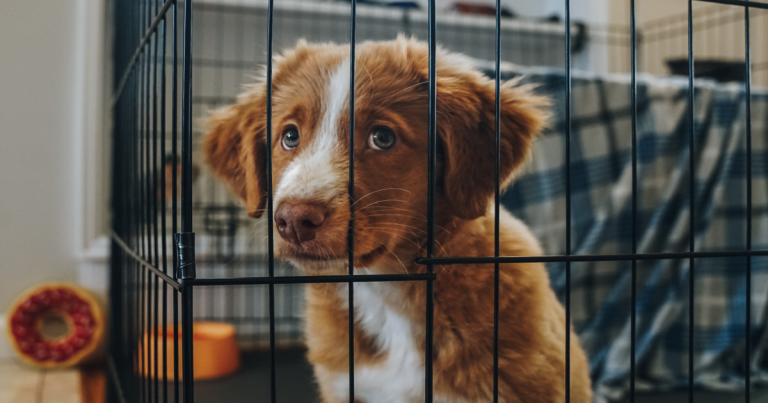
A crate, introduced properly, becomes a puppy’s favorite place: a private den for naps, a safe spot when the house is busy, and the single most useful tool for potty training. Done poorly, it becomes a source of anxiety and crying. The difference is entirely in the method.
Professional dog trainers agree on the core principle: the crate must always predict good things, never punishment. This step-by-step schedule builds that association gradually over about four weeks.
Setting Up the Crate the Right Way
Choose a crate your puppy can stand up, turn around, and lie down in comfortably, but not so large that he can sleep in one corner and use the other as a bathroom. For large-breed puppies, buy the adult-sized crate with a divider panel so the space grows with him.
Place the crate in a lived-in area, not isolated in a garage or basement. Puppies are social sleepers and settle far faster near their people. Make it cozy with a washable blanket or crate pad, add a safe chew toy, and cover part of the crate with a light blanket to create a den-like feel, leaving the front open for airflow. Remove collars and anything with small parts the puppy could chew off before any unsupervised crate time.
Week One: Making the Crate a Happy Place
For the first several days, the door stays open and nothing is forced. Scatter high-value treats around and inside the crate so your puppy discovers them on his own. Feed every meal inside the crate with the door open. Toss in a favorite toy and let him wander in and out freely.
Once he walks in happily, start closing the door for a few seconds while he eats, then open it before he fusses. Gradually stretch the closed-door time to a few minutes while you sit nearby. If he whines, wait for a brief pause before opening, so you reward quiet, not noise. Keep every session short and positive; five good minutes beat twenty stressful ones.
Weeks Two to Four: Building Duration
Week two is for daytime practice. Crate the puppy for short naps after play sessions, starting with thirty to sixty minutes. Stay nearby at first, then begin leaving the room for brief periods. A stuffed frozen food toy makes alone time feel like a treat rather than abandonment.
Week three introduces nighttime crating and longer absences. Most puppies sleep well in the crate beside their owner’s bed, where they can hear breathing and feel secure. Expect one or two nighttime potty breaks for puppies under twelve weeks; set an alarm rather than waiting for crying, which can accidentally train the puppy to cry for attention.
Week four is about routine. By now most puppies trot into the crate on cue for naps and bedtime. Start using a consistent cue word like “crate” or “bed,” said cheerfully right before tossing a treat inside. Practice leaving the house for gradually longer stretches, always returning before the puppy gets distressed.
Sample Daily Schedule and Troubleshooting
A realistic day for a ten-week-old puppy might look like this: 6:30 a.m. potty and breakfast, 7:00 play, 8:00 crate nap, 10:00 potty and play, 11:00 crate nap, 1:00 p.m. lunch and play, 2:00 crate nap, 4:00 potty and play, 5:00 dinner, 6:00 play and training, 8:00 calm wind-down, 9:30 final potty, 10:00 crate for the night. Adjust to your puppy’s age: a common guideline is that puppies can hold their bladder roughly one hour per month of age, up to about eight hours.
If the puppy cries at night: first rule out genuine needs (potty, too hot or cold). Then keep responses boring: a quiet potty trip with no play, straight back to the crate. Most puppies settle within a few nights once the routine is consistent.
If the puppy soils the crate: the space is likely too big, the schedule has gaps, or the puppy was crated too long. Shrink the space, tighten the potty schedule, and clean accidents with an enzymatic cleaner so no odor remains.
If the puppy panics: drooling, escape attempts, or injury mean genuine distress, not stubbornness. Back up to shorter sessions, and consult a certified trainer if it continues. A small percentage of dogs have confinement anxiety and need a different approach, such as a puppy-proofed room or pen.
Crate training is a gift that pays off for years: easier travel, calmer vet stays, and a dog that genuinely loves his own space. Build it slowly, keep it positive, and let the schedule do the work.
#PuppyTraining #CrateTraining #PetTraining #NewPuppy